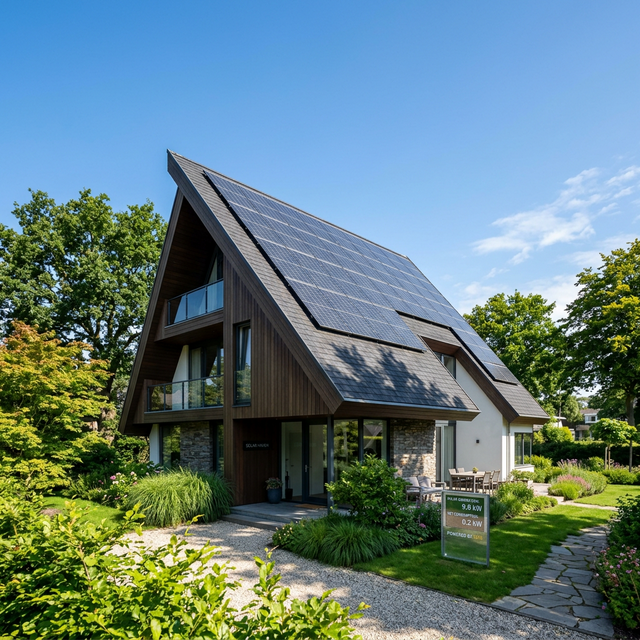
How Roof Pitch Impacts Energy Use
Your roof’s pitch plays a significant role in your home’s energy efficiency, affecting everything from solar heat gain to ventilation effectiveness.
Solar Exposure and Heat Gain
South-Facing Slopes
The angle of a south-facing roof directly affects how much solar radiation it absorbs. In the northern hemisphere:
- Low pitch (2:12 to 4:12): Maximum summer heat absorption
- Moderate pitch (6:12 to 8:12): Balanced year-round performance
- Steep pitch (10:12+): Better winter solar gain, less summer heat
Optimal Angles for Solar Panels
If you’re planning solar panel installation, your roof pitch matters. The ideal angle is roughly equal to your latitude. For most of the US (25°-45° latitude), a roof pitch between 5:12 and 10:12 is optimal.
Ventilation and Air Circulation
Steeper roofs naturally promote better hot air movement through convection:
- Hot air rises more efficiently in steep-pitched attics
- Better ventilation reduces cooling costs in summer
- Proper airflow prevents moisture buildup and ice dams
Insulation Considerations
Flat and Low-Slope Roofs
- Often use continuous rigid insulation above the deck
- Require careful vapor barrier placement
- Can achieve high R-values with spray foam
Cathedral and Steep Ceilings
- May have limited insulation space between rafters
- Spray foam insulation is often the best solution
- Consider structural insulated panels (SIPs) for new construction
Climate-Specific Recommendations
| Climate Zone | Recommended Pitch | Reasoning |
|---|---|---|
| Hot & Dry | 4:12 to 6:12 | Reduces solar absorption |
| Hot & Humid | 6:12 to 8:12 | Promotes airflow and drainage |
| Cold & Snowy | 8:12 to 12:12 | Sheds snow, prevents ice dams |
| Temperate | 5:12 to 7:12 | Balanced performance |
Calculate Your Roof’s Energy Impact
Start by determining your current roof pitch using our calculator. Then consult with a local energy auditor to understand how your specific pitch, orientation, and climate zone interact to affect your energy costs.